Collections

Frank Gurrier

Aviation Pioneer and Artist


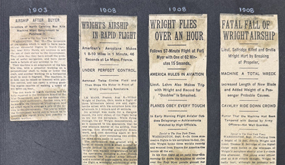
Frank Gurrier served with the 349th Aero Squadron during World War I. Gurrier received his pilots’ training at Kelly Field, Texas in 1917. During this time, Gurrier trained in the Curtis JN-4 (Jenny). After training at Kelly Field, Gurrier and the rest of the 349th deployed to England to support the allies in the war. During training and deployment, Gurrier showcased his artistic side by depicting crashes and other events with small drawings and pencil etchings. Gurrier witnessed and endured multiple crashes during his training and deployment, but returned safely to the United States at the end of World War I. During his time with the Army Air Service and after the War, Gurrier became fascinated with the history of aviation and began collecting articles and pictures that documented flight history beginning in 1903.

Frank Gurrier donated these materials to the Air Force Academy for all his fellow airmen in 1957.

The collection consists of a scrapbook, complied by Major Frank Gurrier, that documents aviation events from 1903 to 1937. Significantly, the scrapbook highlights Gurrier’s service with the 349th Aero Squadron during World War I. The collection is presented in one series in one box.




Selections from the Collection


Early Aviation

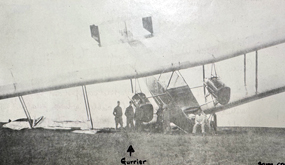
Here is a record of early aviation; news clippings commencing in 1903…photographs of aircraft prior to and through WORLD WAR I…sketches done by the writer immediately following incidents which occurred during his service with 349th Aero Squadron, Aviation Section of the Signal Corps…also autographs of some EARLY BIRDS and WWI PILOTS.

– Major Frank W. Gurrier, CAP-USAFA WWI fighter-bomber pilot.


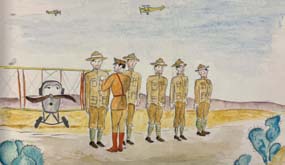
Earning Their Wings:

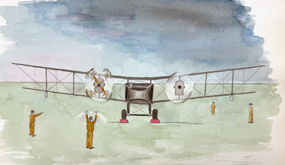
Five “raggety-ass” Cadets of 349th Aero Sqdn., assemble to receive their WINGS, after 8 hours of solo, including one cross-country flight.


My First Crash

One of the German POW’s in the camp compound, had temporarily escaped during the night; had partially cut the elevator cable. The cable snapped while at 1500 ft. altitude, so I brought her down on ailerons.


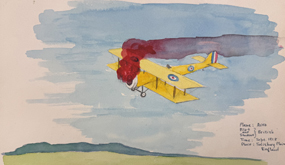
Inflight Fire

They landed…the pilot’s legs badly burned…the student had tried to jump out (we had no parachutes).


Luck Was With Me

I was to have no more crashes. If you didn’t know…in WWI we had no parachutes, flaps or brakes and were fully exposed to weather.


The “Beloved” Jenny (JN-4D)

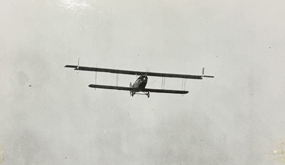
Kelly Field, Texas; training plane of Aviation Section Signal Corps; 1917 – 1918.


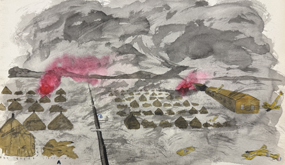
Our Worst Texas Sand Storm